
Introduction
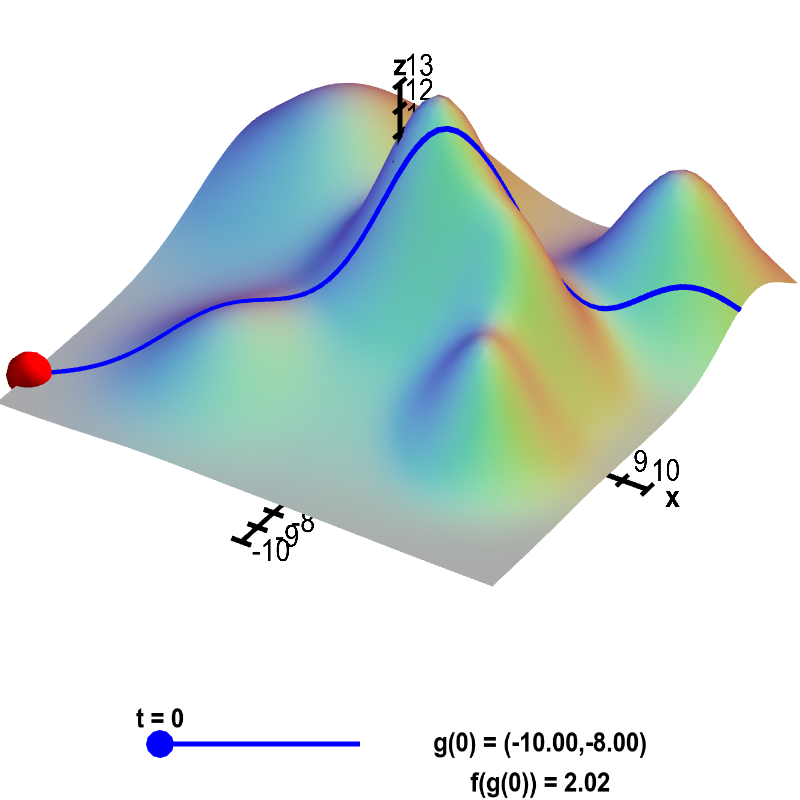
The chain rule is a cornerstone concept in calculus that allows students to differentiate composite functions efficiently. Mastering the Chain Rule is essential for tackling more advanced calculus problems and real-world applications. This guide takes you from basic principles to advanced techniques, providing a comprehensive understanding of the chain rule.
Understanding the Basics
The chain rule is used to differentiate a function composed of two or more functions. If y = f(g(x)), the derivative is
dy/dx = f'(g(x)) * g'(x)
This means you first differentiate the outer function while keeping the inner function unchanged and then multiply by the derivative of the inner function.
Basic Examples
Example 1
Differentiate y = (2x + 3)⁴
- Inner function: g(x) = 2x + 3
- Outer function: f(u) = u⁴
- Derivative: dy/dx = 4(2x + 3)³ * 2 = 8(2x + 3)³
Example 2
Differentiate y = sin(3x)
- Inner function: g(x) = 3x
- Outer function: f(u) = sin(u)
- Derivative: dy/dx = cos(3x) * 3 = 3 cos(3x)
Intermediate Applications
Once you understand the basics, the chain rule can be applied to more complex functions such as exponential, logarithmic, and trigonometric combinations.
Example
Differentiate y = e^(x² + 2x)
- Inner function: g(x) = x² + 2x
- Outer function: f(u) = e^u
- Derivative: dy/dx = e^(x² + 2x) * (2x + 2) = (2x + 2)e^(x² + 2x)
Advanced Techniques
Advanced problems may involve multiple layers of composite functions or combinations with the product and quotient rules. In such cases, identifying all inner and outer functions carefully is crucial.
Example
Differentiate y = (sin(2x²))³
- Outer function: f(u) = u³, inner function: u = sin(2x²), inner-inner: g(x) = 2x²
- Step 1: Derivative of outer: 3(sin(2x²))²
- Step 2: Derivative of inner: cos(2x²) * 4x = 4x cos(2x²)
- Step 3: Multiply: dy/dx = 3(sin(2x²))² * 4x cos(2x²) = 12x (sin(2x²))² cos(2x²)
Tips for Mastery
- Clearly identify all inner and outer functions
- Use parentheses to keep track of composite functions
- Practice progressively from simple to complex problems
- Combine chain rule with product and quotient rules for multi-layered problems
Conclusion
Mastering the chain rule is a gradual process that moves from basic differentiation to advanced applications involving multiple layers of composite functions. Consistent practice and careful identification of functions are key to success. For more educational resources and the latest updates in learning, visit YeemaNews.Com, a site that shares current and practical insights on education.